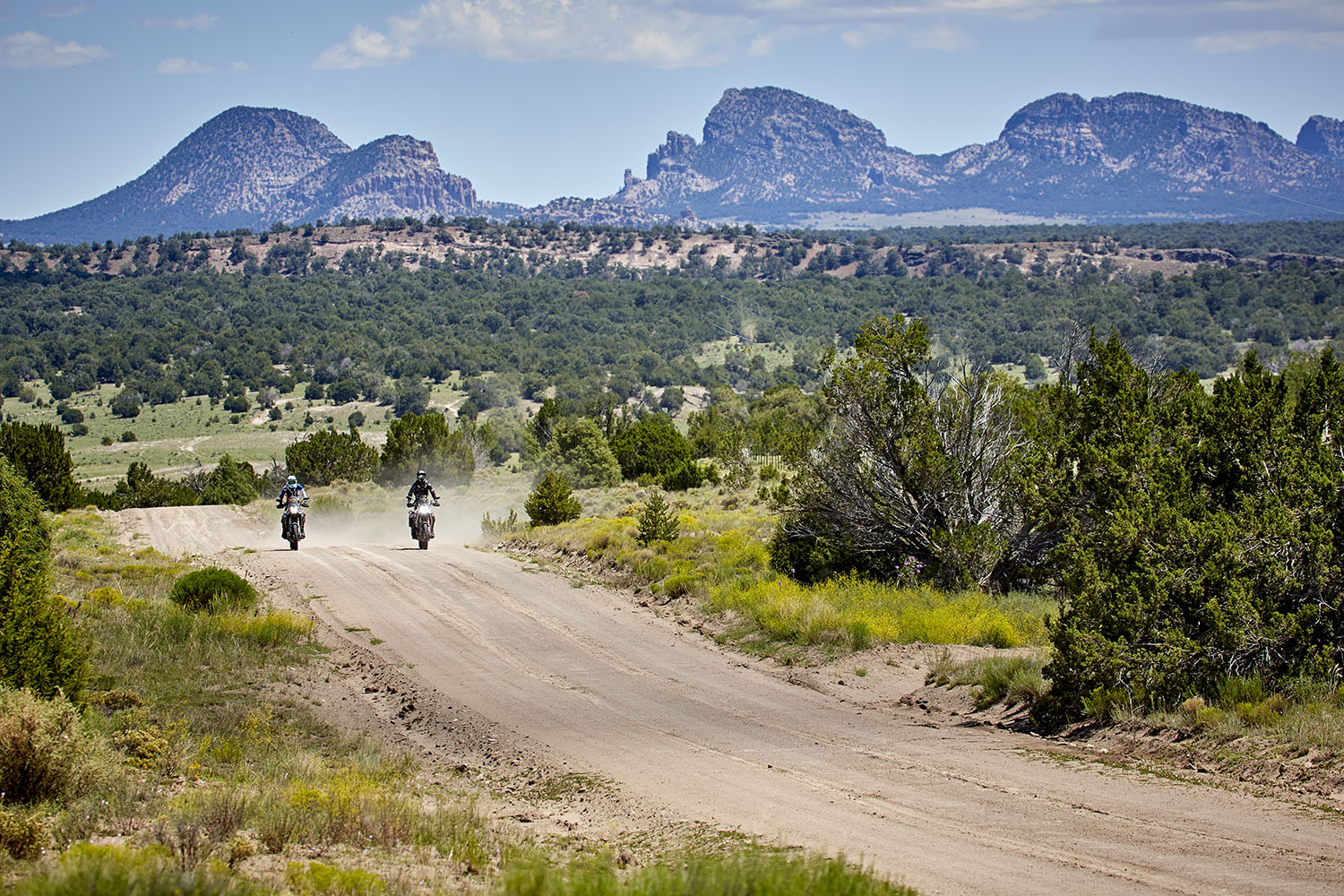
When one looks at a map of Europe, it’s not difficult to imagine the country of Italy shaped as a high-heeled boot with the “toe” kicking the triangle shaped island of Sicily – the largest island of the Mediterranean. However, Sardinia, although the second largest of the Med, is often overlooked. Tourists instead clamor to other crowded Italian destinations like Rome, Venice, Pompeii, and Pisa, which is a shame since Sardinia offers wonderful remote roads, over a thousand miles of exceptional coastline, forested mountain regions, and a uniqueness that is as diverse as any other country in Europe. Sardinia is an excellent choice for those looking to escape the hustle and bustle of mainland Italy – especially those on two wheels with knobby tires.
Trans Euro Trail Options
Readers of our overland travels throughout Europe will have undoubtedly heard of the Trans Euro Trail (TET). This elaborate trail system covers an astonishing 80,000 km (49,700 miles) throughout almost all of the European countries and Sardinia is no exception. The Italian portion, that includes 750 km (465 miles) of trails in Sardinia, was designed by linesman Simone Amicabile, and provides the options of starting from the two northern ferry port destinations of Porto Torres and Santa Teresa Gallura.
Our discovery of Sardinia started in the most northern town of Santa Teresa Gallura. Since we had many interesting sites that were not near the TET route, we chose to forgo riding the TET as we zig-zagged throughout the island to reach the capital city of Cagliari on the southern tip. Fortunately, there are plenty of other excellent roads and trails that connect the five major provinces of Sardinia – Sassari, Oristano, Sud (South) Sardinia, Nuoro, and Cagliari.


Spectacular Sassari
We quickly put the ferry port of Santa Teresa Gallura in our side-view mirrors, and rode the short distance to Copa Testa. A narrow isthmus connects this peninsula to the mainland and is definitely worth the short stop to enjoy the stunning scenery. Multiple hiking trails create a “choose-your-own-adventure” that offer sensational views of the blue waters of the Mediterranean and large granite boulders that have been shaped by millenniums of wind and sea. We curiously hiked along the shore where we discovered the Copa Testa lighthouse, lizards, tortoises, and fields of purple ice-plants.
Riding along the northwest coast brought us to the picturesque seaside town of Castelsardo. Bright, pastel-colored homes are built on a rocky hill centered around the stone remains of a 12th-century Medieval castle that sits prominently above the shore. One could easily spend a few days here, enjoying afternoon strolls through the narrow streets and colorful shops, relaxing on the many nearby beaches, and soaking in the vibe of Italian island life.
There are many sites worth visiting within a short ride from Castelsardo. Just 1.5 hours southwest is Neptune’s Grotto - a beautiful cave complex that was discovered by fisherman in the 1700s and named after the Roman god of the sea. Over the last century, it has slowly morphed into a well-visited tourist spot that requires a tour guide to visit. However, Chantil and I both agreed, it was worth it – especially during the less-visited shoulder month of April.
Less than an hour south of Castelsardo is the charming Basilica of the Holy Trinity Saccargia. This Romanesque styled church was constructed entirely from local stones consisting of black basalt and white limestone and was completed in 1116 – nearly 300 years before Christopher Columbus landed on the shores of the Bahamas. In the 16th century it was abandoned, but recent efforts have restored it so that future generations can appreciate its beauty among the tranquil countryside.


Olden Oristano
It was during our ride through the central region of the Oristano province that we discovered the first of many ancient necropolises. These rock-cut tombs were the final resting place of the Ozieri culture that lived on the island from 3,200 to 2,800 BC. More than 2,400 tombs have been found in Sardinia with some of them being preserved archaeological sites. However, most of these Bronze Age tombs are just left in the open to explore – we found them on the sides of rural roads, and even wedged between homes and markets in small villages.
While visiting the Archaeological Park of Santa Cristina, we also learned about another ancient civilization of Sardinia – The Nuragic culture. This civilization occupied much of the island from 18th century BC to the Roman colonization of 200 BC. Although no written record of the Nuragic culture has been discovered, much of what is known of this ancient civilization can be learned through their architecture, religious sites, Bronze Age tools and weapons, and sculptures. While at the archeological site we marveled at the construction of the Nuragic well that was masterfully created over 3,000 years ago. The perfectly aligned and placed trapezoidal stones of the walls and ceiling were created with such astronomical precision that the sun’s rays shine directly into the bottom of the well at noon on the spring and autumn equinoxes!
As impressive as the architecture and craftsmanship of the sacred well was – it didn’t compare to the grandeur of another Nuragic structure we visited while passing through the Sud Sardinia province.

Sud (South) Sardinia Surprises
When we showed up at one of Sardinia’s most visited sites, we were not impressed. The parking lot was chock full of tour busses, cars were spilling out into the narrow roadway, and hundreds of tourists waited in a long line to purchase tickets. My anxiety of being around large crowds was already kicking in. “No way am I dealing with all that craziness!” I said into the Bluetooth headset to Chantil.
“I agree!”, she nodded. “I don’t understand why there are so many people here on a Monday.”
“No kidding. Normally Mondays are some of the best times to visit popular sites like this.”
After we rode away from the chaos of over-tourism, we pulled over and tried to understand why. A quick Google search of “Italian holidays” gave us the answer – today was Easter Monday.
We decided to find a nearby Airbnb and visit Su Nuragic the next morning with the hopes that it would be much less crowded – especially if we planned to be there when the gates opened at 9 AM.
The next morning, we arrived to an empty parking lot. Was the site closed? Perhaps after the Easter holiday? Thankfully we found the ticket booth open, were quickly provided a guide that spoke excellent English, and enjoyed the next hour of having a personalized tour of the entire Archeological site. Moral of the story – know the holidays of the country in which you are traveling and arrive to popular sites early in the morning, well before the tour busses.
We had no idea Su Nuraxi of Barumini would be so interesting. This UNESCO World Heritage Site is described as “The finest and most complete architectural example of the prehistoric Nuragic civilization from the 2nd millennium BC.” As we walked among the hundreds of stone hut foundations, we were fascinated by the preservation of the imposing 18-meter (59-foot) main tower, adjoining side towers, a functioning canal system, and retractable wall entrances. All this was very impressive, especially considering that most of humanity was still living in wooden huts or caves during this period of over 4,000 years ago.
After a bit of tourism, we were eager to balance it out with some sensational riding. Fortunately, the SS126 was just a short hour ride to the southwest. The website Motorcycle Diaries describes the SS126 as “Sardinia’s Stelvio”. Since I’d ridden many of the most popular passes of the Alps (UPSHIFT issue 70) we decided to give it a ride to find out for ourselves.
From the town of Arbus, the SS126 snakes 45km (28 miles) through the Mediterranean countryside of rolling hills covered in thick bushes and short trees. The riding was reminiscent of when I first started riding motorcycles in east San Diego County of southern California. The road is narrow, well maintained, not that crowded, and oh-so-twisty – perfect for a mid-morning spirited ride. Be sure to stop at the Temple of Antas and enjoy the remains of a Carthaginian-Roman temple, village ruins, and ancient limestone quarry. The SS126 continues south all the way to Sant’Antioco Island, but after crossing the Corsi Lake Bridge the road straightens out and passes through numerous small towns and villages.
Is the SS126 “Sardinia’s Stelvio”? Not so much. Although both offered well-maintained roads and spirited riding, the Stelvio is unmatched with its stunning Alpine views, and incredibly tight switchbacks. Winner Stelvio!


Notorious Nuoro
If you’re looking for more twisty roads to tame, then the SS125 is also worth your time. This route runs along the entire east coast of the island from the northern ferry port in Palau to the southern port of Cagliari, winding through 354 km (220 miles) of the most dramatic and remote regions of Sardinia. We didn’t experience this entire route, but thoroughly enjoyed the central portion that passes through the Nuoro Providence and Gennargentu National Park. It’s a popular route offering towering cliffs, deep gorges, and occasional views of the crystal-clear waters of the Mediterranean Sea.


Captivating Cagliari
After reaching the southern city of Cagliari, Chantil and I felt a bit saddened that we were coming to the end of an excellent road trip. Up to this point, Sardinia had surpassed our expectations with wonderful riding conditions, a relaxed island-style vibe, and an intriguing history – especially the Nuragic civilizations. However, our trip wasn’t over yet – we still had one more surprise at the National Archaeological Museum of Cagliari.
This small, but well-designed museum houses many artifacts of ancient Sardinia to include a large collection of pre-Nuragic, Nuragic age, and Byzantine age artifacts. However, the crown jewel of the museum is the exhibit known as the Mont’e Prama Giants. In 1974 Sardinian farmers were plowing their fields when they stumbled upon a portion of a limestone statue. They immediately knew that there was something special about it and contacted the authorities, who reached out to archeologists. An excavation began which uncovered 5,178 artifacts of various dimensions, however since there were no funds to reconstruct them, they were locked away in a museum vault in Cagliari and nearly forgotten over the next 30 years.
It wasn’t until 2005, and after some funding, that the universities of Cagliari and Sassari began the incredibly difficult process of reassembling the statues. By 2014, enough reconstruction had occurred to display 27 hero statues, with the Archaeological Museum of Cagliari displaying 18 of them: 13 boxers, 3 archers, and 2 warriors.
As we marveled at the collection of giants, some standing almost 7 feet tall, we contemplated about how much of the world is still yet to be discovered. How many more ancient artifacts are still buried below the surface waiting to be found? How many more curvy roads, and backcountry trails are still waiting for us to personally explore? Although our 17-days of motorcycle touring in Sardinia definitely lived up to our expectations, we still had many more places we wanted to see and experience.
The next morning, we excitedly rode aboard the next ferry that was bound for the island of Sicily and the capital city of Palermo. We had plans to stay for the weekend in the city and then hop aboard the next ferry bound for Tunisia, North Africa. More adventure awaits…
About viajarMOTO
Travis and Chantil Gill retired in March 2020 and started full-time motorcycle overlanding.. You can follow their journey at www.viajarMOTO.com.